Understanding Subsolar Penetrations
A subsolar penetration is a clinical emergency. Knowing what to do during the first few minutes can significantly influence your horse's chances of making a full recovery.
This Is a Clinical Emergency
If your horse suffers a subsolar penetration, contact your veterinary surgeon immediately.
If possible, do not remove the object until you have spoken to your vet. The depth, angle and exact point of entry may be critical when planning treatment.
What Is a Subsolar Penetration?
A subsolar penetration occurs when a foreign object enters the solar or basal surface of the hoof. The object may be a nail, screw, piece of wire, sharp stone or any other material capable of penetrating the foot.
Although some penetrations appear minor externally, the damage beneath the hoof capsule may be far more significant.
Why Some Areas Are More Dangerous Than Others
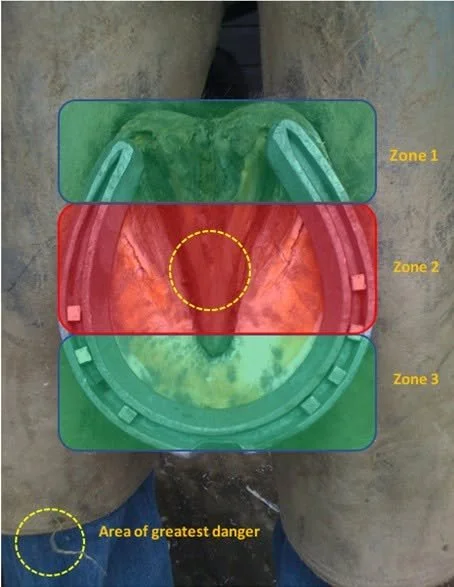
Not every penetration carries the same level of risk. For practical purposes, the solar surface can be divided into three zones (Figure 1). Although every penetration requires urgent veterinary assessment, injuries involving Zone 2 present the greatest concern because of the important anatomical structures immediately beneath this area.
Figure 1. Practical zones of subsolar penetration. Zone 2, particularly the central region, carries the greatest risk.
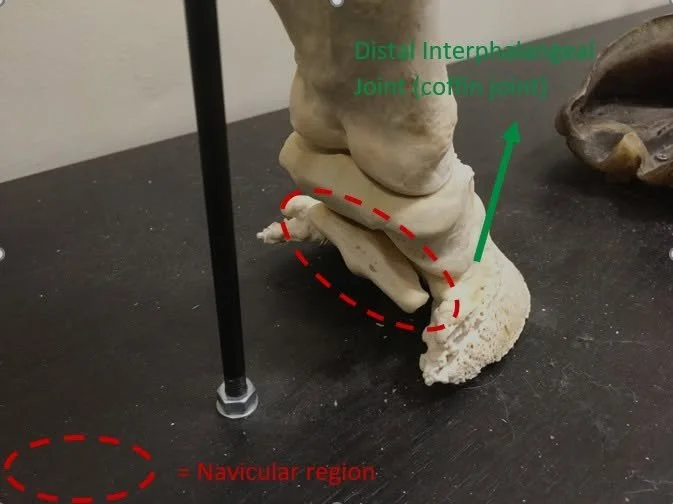
Beneath Zone 2 lies the navicular region, including the navicular bursa and the distal interphalangeal (coffin) joint (Figure 2). If either structure is penetrated or becomes infected, the consequences can be extremely serious despite modern veterinary treatment.
Figure 2. Important anatomical structures beneath Zone 2, including the navicular region and distal interphalangeal (coffin) joint.
Immediate First Aid
If the object is still in the foot:
1. Do not remove it unless advised by your veterinary surgeon.
2. Prevent it being driven deeper by placing wooden blocks or similar material either side of the object where possible.
3. If someone is with you, ask them to contact your veterinary surgeon immediately while you stabilise the foot.
4. Keep the horse standing quietly on a firm, level surface.
5. Do not place the horse onto shavings or deep bedding, as the object may be pushed further into the foot.
If the Object Has Already Been Removed
If the object has already been removed, either in panic or following veterinary advice:
· Keep the object for your veterinary surgeon.
· Make a note of the exact point of entry.
· Record the angle and approximate depth of penetration if known.
· Apply firm pressure if bleeding is significant.
· Keep the foot as clean as possible.
· Do not allow the horse to walk around unnecessarily or stand on contaminated bedding.
Penetrations through the frog deserve particular care because the hole may close rapidly, making the original point of entry difficult to identify.
Veterinary Treatment
Your veterinary surgeon will assess the depth, angle and location of the penetration before deciding whether further imaging, such as radiographs, is required. Depending on the injury, treatment may include a street nail procedure, wound management, antibiotics, tetanus protection and ongoing monitoring.
Your farrier may also be involved in the recovery, providing supportive or therapeutic shoeing or fitting a hospital plate where appropriate.
Recovery
Most horses recover well following prompt veterinary treatment. Recovery time varies depending on the structures involved, and some cases require prolonged box rest and careful rehabilitation.
Summary
· Every subsolar penetration is a veterinary emergency.
· Leave the object in place whenever possible.
· Zone 2 injuries carry the greatest risk.
· Record the point of entry, angle and depth if the object is removed.
· Prompt veterinary treatment gives the best chance of a successful outcome.
A Final Thought
Sometimes the most important first aid is knowing when not to act.
A few minutes of patience before removing the object may protect structures your veterinary surgeon cannot replace.
About the HØØF Knowledge Hub
The HØØF Knowledge Hub exists to provide horse owners with clear, practical and evidence-based information on hoof health, lower limb conditions and farriery.
Every horse is an individual, and no online article can replace professional assessment. If you have any concerns about your horse's health or soundness, always seek advice from your veterinary surgeon or registered farrier.
Article Information
Author: Paul Conroy BSc (Hons) AWCF
Organisation: HØØF Equine Hoof Care
Category: Hoof Emergencies
Document Reference: HKH009
First Published: July 2026
Last Reviewed: July 2026
© 2026 HØØF Equine Hoof Care. All rights reserved.